The 2026 market for Linear Motors is becoming more practical, specialized, and globally competitive. Manufacturers now serve semiconductor equipment, factory automation, packaging, robotics, medical devices, and high-speed transport. Buyers need more than attractive specifications. They must examine force output, acceleration, repeatability, thermal behavior, encoder compatibility, service coverage, and total ownership cost.
“ A linear motor is simply an electric motor rolled out flat.” — Professor Eric Laithwaite, a recognized pioneer in linear motor technology.
That simple description hides important engineering differences. A motor designed for cleanroom positioning may not suit a dusty machining line. A compact voice-coil actuator may deliver excellent precision but limited continuous force. In contrast, tubular and iron-core designs can support heavier loads, although cogging, heat, and maintenance requirements deserve careful review. Small details matter. Cable routing matters too.
This guide introduces leading Linear Motors manufacturers for global buyers in 2026. It considers product breadth, manufacturing experience, motion-control integration, customization capability, documented performance, and international technical support. Public data can be uneven. Some companies publish detailed test conditions, while others provide only headline figures. That weakness should not be ignored. Buyers should request application-specific curves, duty-cycle information, warranty terms, and regional service contacts before making a decision.
The strongest supplier is not always the largest. It is the one that fits the application reliably. Performance must survive real production. That is where comparisons become difficult, and sometimes imperfect.
What Are Linear Motors and How Do They Work?
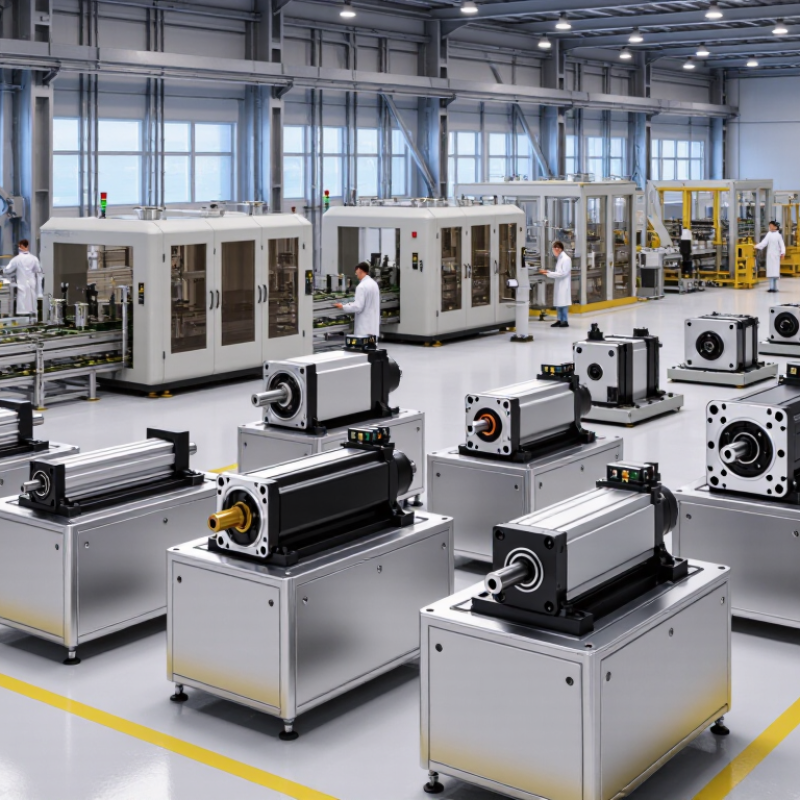
A linear motor creates straight-line motion without converting rotary motion through a screw, belt, or crank. Its moving part, often called the forcer, carries coils or permanent magnets. The stationary track supplies the magnetic field. When controlled current flows through the coils, electromagnetic force pushes the forcer along the track. Direction changes when the controller changes current timing.
The principle resembles an unwound rotary motor. A servo drive regulates phase, current, and acceleration. An encoder reports position, sometimes within a few micrometers. This closed-loop signal helps a machine move smoothly while carrying glass panels, tools, or semiconductor wafers. There is no mechanical screw contact. That reduces backlash and can support rapid, repeated travel.
Industry data shows growing demand. Grand View Research estimates the global linear motor market will expand at about 7.5% annually from 2024 to 2030. The report connects growth with automation, electronics production, and precision equipment. MarketsandMarkets also identifies high-speed positioning as a major application area in its 2024 motion-control analysis. These figures are useful, but not perfect. Market definitions differ between reports.
In practical testing, heat remains important. Coil temperature can rise during repeated acceleration. Cable movement also deserves attention. A poorly selected encoder may limit accuracy more than the motor itself. Engineers should compare continuous force, peak force, duty cycle, stiffness, and cooling conditions. Speed alone is not enough.
Key Criteria for Evaluating Linear Motor Manufacturers in 2026
2026 Top Linear Motors Manufacturers for Global Buyers
Key Criteria for Evaluating Linear Motor Manufacturers in 2026
Choosing a linear motor manufacturer requires more than comparing peak force. Check continuous force, acceleration, positioning repeatability, and force ripple under realistic loads. Ask for test data from a motor with similar stroke length and duty cycle. A clean laboratory chart may not reflect dust, heat, or cable movement on your production floor. Thermal behavior matters. Request winding temperature records after extended operation, not only short demonstration results.
Tips: Visit the factory if practical. Observe winding control, magnet handling, inspection points, and final testing. Ask how failed units are traced. Confirm whether engineers provide load calculations, tuning support, and replacement guidance. Review certifications, material traceability, export documentation, and stated service response times. Small details often reveal process maturity. Keep written records of every promise.
A reliable supplier should explain tolerances in plain language and provide measurable acceptance criteria. Evaluate encoder compatibility, controller integration, maintenance requirements, and expected operating life. Compare lead times using recent production evidence, not optimistic estimates. Request references from applications with similar speed, payload, and accuracy demands. No scorecard is perfect. Procurement teams can still miss hidden costs, especially integration labor and spare modules. A manufacturer that admits technical limits may deserve more trust than one offering effortless performance claims.
Leading Linear Motor Manufacturers for International Buyers
The 2026 Top Linear Motors Manufacturers for Global Buyers will be judged by more than catalog speed. International buyers need stable thrust, repeatable positioning, and documented quality control. MarketsandMarkets estimates the global linear motor market could reach about USD 1.5 billion by 2028, supported by automation, electronics, and precision assembly. That growth creates choice, but also confusion. A polished website is not technical evidence.
Leading Linear Motor Manufacturers for International Buyers should provide measurable data. Buyers should request continuous and peak force curves, encoder resolution, thermal limits, duty-cycle test results, and stated tolerances. A motor rated at 500 N may deliver less under high acceleration or poor cooling. Check the complete axis, not only the motor. Look for testing aligned with IEC 61800 requirements and documented risk controls for the finished machine.
Real experience appears in application details. A cleanroom stage may require low particle generation, while a packaging line may prioritize washdown resistance and rapid acceleration. MarketsandMarkets also identifies semiconductor and electronics production as important demand areas, where micron-level repeatability can affect yield. Ask for sample test reports, spare-part timelines, export documentation, and local service coverage. Small omissions become expensive delays. One weakness remains common: published accuracy figures may reflect ideal laboratory conditions, not a warm factory floor. Verify performance at your actual load, temperature, travel length, and operating cycle.
How Major Linear Motor Brands Compare by Application and Performance
2026 Top Linear Motors Manufacturers for Global Buyers
How Major Linear Motor Brands Compare by Application and Performance
Selecting a linear motor starts with the application, not the catalog headline. Semiconductor stages demand nanometer-level repeatability, low heat, and clean operation. Packaging lines usually value acceleration, uptime, and simple maintenance.
MarketsandMarkets estimates the global linear motor market could grow from about USD 1.2 billion in 2023 to nearly USD 1.9 billion by 2028. That growth reflects wider use in automation, electronics, and precision equipment. Still, forecasts are not guarantees.
For high-speed pick-and-place systems, tubular and flat linear motors can exceed several meters per second. Their real advantage appears in short travel cycles. Precision stages need better thermal control and feedback resolution.
A 1-micron encoder does not automatically create 1-micron accuracy. Mechanical stiffness, cable drag, calibration, and vibration still matter. This is where many comparison tables oversimplify performance.
Interchangeable motors may look similar, yet their cooling methods can produce different continuous-force results. Buyers should compare force at duty cycle, not peak force alone.
Interact Analysis identifies motion control as a strong automation growth area, supported by factory digitization and rising equipment flexibility. Supplier testing should include repeatability, settling time, noise, and performance after long operation.
A practical factory trial often reveals more than a polished datasheet. Some specifications remain unclear. That deserves scrutiny.
Global Purchasing Factors for Linear Motors in 2026
2026 Top Linear Motors Manufacturers for Global Buyers
Global purchasing decisions for linear motors now depend on more than peak force. Buyers should match force, stroke, speed, and duty cycle to the real machine profile. A motor running 24 hours needs different thermal margins than one moving ten times per hour. Measure acceleration at the tool, not only in a catalog.
Thermal behavior deserves close attention. Check winding temperature, cooling options, and performance after repeated cycles. Request test data at your intended load and ambient temperature. Feedback compatibility also matters, especially for machines requiring sub-micron positioning. Confirm encoder interfaces, cable lengths, controller protocols, and replacement procedures before placing a large order.
Certification and regional support can affect the purchase more than a small price difference. Verify applicable electrical, electromagnetic, and safety documentation for each destination market. Ask about production capacity, lead times, spare parts, and technical response hours. A documented factory acceptance test can expose vibration, noise, or repeatability problems early.
Total cost is easy to underestimate. Include installation labor, cooling hardware, tuning time, freight, import charges, and possible downtime. A spreadsheet can still mislead. Pilot testing remains valuable, even when the specifications look excellent. Experienced buyers should also review supplier consistency across several production batches, because one successful sample does not prove long-term reliability.
2026 Top Linear Motors Manufacturers for Global Buyers
Global Purchasing Factors for Linear Motors in 2026
The chart presents a procurement planning index from 0 to 100 for the main factors typically evaluated when sourcing linear motors internationally. Performance, precision, thermal stability, service support, energy efficiency, integration compatibility, and total cost should be assessed together because the most suitable solution depends on the application, duty cycle, load, travel distance, and control architecture.
Index values are a comparative buyer-evaluation framework rather than market-share or company-specific data.
FAQS
A linear motor creates straight-line movement without screws, belts, or cranks. Its moving part travels along a stationary magnetic track.
Controlled current flows through coils and creates electromagnetic force. The controller changes current timing to reverse direction. Simple idea.
A servo drive regulates current, phase, and acceleration. An encoder reports position, sometimes within a few micrometers.
They move glass panels, tools, semiconductor wafers, and packaging components. Short, repeated travel is especially suitable.
No. Mechanical stiffness, vibration, cable drag, calibration, and thermal changes also affect accuracy. The encoder is only one piece.
Compare continuous force, peak force, duty cycle, stiffness, cooling, repeatability, settling time, and noise. Speed alone misleads.
Repeated acceleration can raise coil temperature. Poor cooling may reduce continuous force or affect positioning. Measure heat after long operation.
Not always. Different cooling methods can produce different continuous-force results. Datasheets may hide important operating conditions.
Run a factory trial with real loads and travel cycles. Check performance after extended operation, not only during a short demonstration.
They require careful feedback, thermal control, cable management, and mechanical design. Market forecasts are useful, but never guarantees.
Conclusion
This guide explores how Linear Motors generate direct, precise motion without relying on traditional rotary-to-linear mechanisms. It explains their basic operating principles and highlights the factors buyers should consider when evaluating manufacturers in 2026, including thrust, speed, positioning accuracy, thermal management, durability, energy efficiency, product customization, quality control, and technical support. These criteria help international purchasers identify suppliers capable of meeting demanding requirements across automation, semiconductor production, packaging, robotics, transportation, and other advanced industrial applications.
The article also compares major types of Linear Motors by application and performance, showing how different designs balance acceleration, continuous force, precision, operating life, and maintenance needs. In addition, it examines important global purchasing considerations such as compatibility with control systems, documentation, lead times, warranty coverage, after-sales service, shipping arrangements, compliance requirements, and total cost of ownership. By combining technical evaluation with practical sourcing guidance, the overview helps buyers make informed decisions and select solutions that support reliable, efficient, and scalable operations.
 Precision Micros
